Thursday, 28 March 2019

Madeira - Day 53 - threatening rain.


The weather forecast said 60% to 70% chance of rain (depending which one I looked at) so I decided I'd have a day at home.
I finished "The Lightkeeper's Daughters" by Jean E Pendziwol. Excellent book. I recommend it. It didn't rain so by late afternoon I decided to just get out of the house.
I just walked a couple of blocks down the street to buy a bottle of wine. This little store is about the size of a Toronto condo living room but has fruit and veg, milk, bread, pizza, wine and baked goods. The proprietress saw me eyeing the custard tarts and a chocolate cake. She took the glass cover off the cake and made to wave it under my nose, laughing. I couldn't help myself. I bought a slice to have for dessert at supper.

I walked up Entrada dos Colonos, my little dead end street, to get a different view of the house and terrace. See what I mean about those clouds but it never did rain.

Next to me is the other side of the semi, where Joao, Blanca and the twins live. Next to them are Joao's parents and next to them is this vacant lot.
There's a sign on the gate that looks like someone is looking for building permission on the lot and an expanse of land behind the houses.

The house I am staying in is written over with Santa Luzia.

Now I am really curious, that's a huge parcel of land. I wonder what they are going to build.

Madeira - Day 52 cont - English Church

It's bucketing rain outside, been threatening all day, and its Day 54 and I am still posting about Day 52 ..... time to get caught up.

After my Sopa Verde lunch I walked across the street to the gardens of Quinta das Cruzes (the museum wasn't open, I may not get to see this one) just enjoying the peace and flowers.
I posted about this tree before. Those fruit, that look like avocados, aren't.
The fruit falls and breaks open

revealing what looks like a white fluffy brain
full of seeds. I tried to "google" it but "white fluffy seed pods" just got me Cottonwood Poplars and I know all about those. Heather informs me that this is a Silk Floss tree, native to South America. Thanks to my intrepid reader.

I wandered in the "archaeological garden" again but couldn't find a place to sit and sketch so I headed down the hill along a different street.

I had seen this temple like building form above and when I got to it
found it was the English Church. The guidebook describes it as a "neoclassical building (1822)" and when I got home I realized that I hadn't taken a picture of the outside. It was a square building with a dome and columns across the front porch. Didn't look like a church at all.
Quite a concert schedule.
Inside, a brochure, spoke of a small congregation of resident expats and that it increases with the English down for long stay holidays.

Inside it was circular,
below the dome.
Outside there was a cemetery and a garden that looked like a bowling green. How did they find that flat space?
The stations of the cross were blue and white tile,

scattered around the church and its grounds.

On the way home .... I love that mail is delivered by scooter or ATV.

Wednesday, 27 March 2019

Madeira - Day 52 cont - Convento de Santa Clara

From the downtown, with its decorative side walks

I walked up the hill towards the fortress that Nicola, Dave and I visited.
I was rushing a little  (not something I like to do while going up a steep hill) because the convent closes at 12 and doesn't open again until 3 and I didn't want to have to kill that much time. It was 11:50 when I rang the bell at the gate in the stone wall that surrounds the convent.

I was admitted by a woman who was sweeping and she took me into an office, took my 2 Euro coin and spoke into a phone, directing me to wait
and then to follow her through the church until we found an earlier tour, in progress, that I joined.
Susan, the guide, spoke very good English and explained that the Franciscan order of Santa Clara was a very strict order and the cloister was one of the few ways that the sisters could get fresh air as they had no contact with the outside world.
Most of them were sent as young girls, usually second daughters, from wealthy families.
The convent received some funding from those wealthy families but also had a garden and the centre of the cloister was full of fruit trees. They also had servants.
Susan pointed out the kestrel up on the bell tower, saying that she thought it had a nest up there.
Susan showed us one of the many chapels on the property. Every inch was decorated, including the wooden doors. Tiled walls and

painted ceiling.
Next we went into the church where the public came for services.
More tiled walls, flagstone floor, wooden pews,
painted ceiling
and a 17th century organ that Susan opened up and foot pumped while one of our tour group played. She says she often has someone on the group who is a church organist.
Two rooms at the back of the church were for the members of the order. The nuns downstairs took communion through the hole in the wooden grill. The novices upstairs were allowed to sing. It was a silent order with their time spent in meditation and prayer. The rest of the group left at this point and Susan showed me what I had missed from the beginning of the tour.
The seats where the nuns sat while listening to the church service and where they conducted their daily prayers.
The one with the crown was for the Mother Superior.
Everywhere there was tile work, paintings and decoration. Susan explained that a lot was commissioned and paid for by the wealthy patrons. This was a time when sugar and wine were creating a lot of wealth on Madeira.
As it was just me, she took me upstairs to where the novices would listen to the service and showed me the green Moorish tiles on the floor. So old that they were still importing them from Morocco and had not yet established their own blue, white and yellow styles.
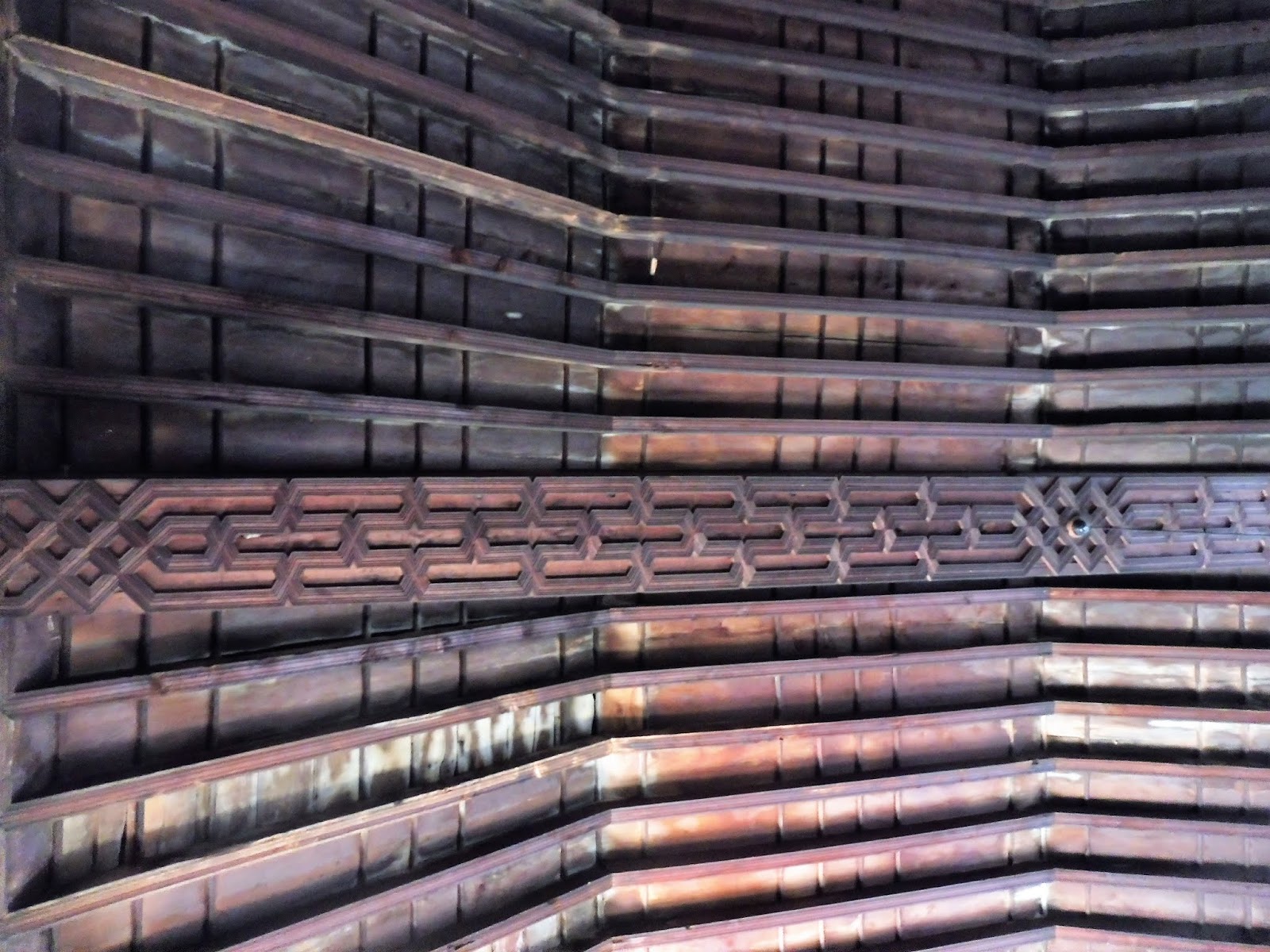
She also pointed out the carved beams on the ceiling, in the same designs as those found in the Cathedral.
Stepping out on to the veranda she unlocked a cabinet and opened its doors. She told me that some of the decorations in the convent were done by the nuns themselves. We looked closely at this one and she pointed out the rather feminine form of Jesus (his waist, his pose etc) as the nuns would never have seen a mans body.
The convent is still owned by the Franciscan Order but the Santa Clara section has moved to another convent in Funchal and one in Camara dos Lobos. The order here now is permitted to interact with the community and can be teachers and nurses. There is a school in one section of the convent now.
As Susan escorted me out a man came in to tune the organ before the organist came to practice, they both said I could sit and listen and make my own way out.


I walked across the street to a snack bar populated entirely by locals having their lunch.

I ordered Sopa Verde. This is a Portuguese specialty, a potato and kale soup with a bit of spicy sausage thrown in to give it a kick. It was creamy and delicious. That and a glass of wine cost me 3.50 Euro (about $5).
The view out the door, from my seat, was the convent wall and the bell tower.
According to my guidebook the convent was established in 1476. The nuns moved in in 1497. They fled from pirates in1566 (to the Nuns Valley) and the school was established in 1927.

Tuesday, 26 March 2019

Madeira - Day 52 - Checking off some boxes

I have been here more than 7 weeks but there are still things I haven't seen so when today proved the forecasters wrong, bright and sunny, I set of early to see if I could check off some things.

On the walk down the hill, a wrought iron decoration on the peak of a roof. The rain last night had washed away the heat and humidity and it was a very comfortable temperature for walking.
Sculpture of a woman embroidering in front of the Embroidery (Bordado) Museum building.
I have walked past here so many times and the door has been closed. Today it was open.

At the top of the stairs

a tapestry, entitled "The Allegory of Madeira",

made by 14 girls over a period of 3 years (1958- 1961)
with a total of 7 million stitches. It is fading but still magnificent.
I was not permitted to take pictures but there were 2 rooms with numerous examples of the tapestry, cutwork, lace making and embroidery that Madeira became famous for. Embroidery became a way to make money, for the women of the island, after the vineyards were hit with a disease that destroyed the wine making industry for decades. It was also an occupation of the rich who sewed for their trousseau on patterns that were handed down for generations. Ornate, inlaid wood sewing boxes and inlaid wood sewing tables were also on display. A video was playing, in Portuguese, that showed how the willows were cut and prepared for the furniture and basket making that I had seen before.

The bad weather had caused a bit of a problem in the harbour with 2 cruise ships that should have left opting to stay and 2 more needing to come in. This one was just leaving. The "parallel parking" last night must have been quite entertaining.
I glanced into the Regional Government building and just had to go in to look at the tiles.
covering every nook and cranny
including under the water fountain
for the turtles that seemed to be posing for us to take pictures.

A more modern section of the building also had tiles (the plug receptacle looks, somehow, out of place)
and a massive wall mural depicting banana harvest,
wine making,

wicker making,
fishing and

sugar cane harvest.

I continued up the hill and visited the Santa Clara Convent, had Sopa Verde and went to the English Church but that'a all for the next post.